
When you are ready to hire a commercial cleaning service, it is tempting to compare the two or three quotes that arrive fastest and pick the lowest. The problem is that cleaning quotes are not comparable at the surface level. A scope can be written so thinly that it looks cheaper for a good reason, and the difference only shows up in the building a few months later.
Here is what actually matters when evaluating a commercial cleaning company, in rough order of importance.
1. Insurance and Bonding — Ask for Documentation
This is first for a practical reason: you are handing a stranger keys to your building and access to the equipment, computers and inventory inside it. Workers’ compensation coverage protects you if a cleaner is injured on your property. General liability covers damage to your property or to a third party. Bonding gives you recourse if the provider fails to meet the terms of the contract.
Ask for the certificate and confirm it is current — not a checkbox on a website, but a document naming your company as the certificate holder. A certificate is also easy to get, which means a certificate alone is not proof of anything. The better question is whether the company carries limits appropriate to the value in your building, and whether that coverage has stayed continuous.
Being uninsured is also a signal about how the company runs. If a provider cannot afford coverage, it is a sign of where the business puts its costs, and you will be paying for that in other ways.
2. References You Can Actually Call
References matter, but only if you use them correctly. A single enthusiastic reference selected by the sales team tells you almost nothing. Ask for three, and specifically for the client closest to your situation — similar size, similar facility type, similar schedule.
Then ask the questions that produce real information:
- What were they like on the first few visits, before they got comfortable?
- How do they handle something you called them about — a missed area, a complaint?
- Is the same crew still assigned to your building?
- What would you change about the service?
The last question is the useful one. A client who answers “nothing, they’re excellent” without hesitation is not giving you information. A client who says “they are slow to return calls after hours” has told you exactly what your experience will be like.
3. Employees, Not Subcontractors
This one is frequently missed and it quietly determines everything else. A substantial share of cleaning companies operate by hiring subcontractors for individual accounts.
The effect on you is straightforward. You do not know who is entering your building, or how they were vetted. Nobody on site has institutional knowledge of your facility, so quality resets with every change in staffing. Supervision is thinner. There is no continuity of ownership when something goes wrong, because the person responsible may have moved on.
Ask directly whether the people cleaning your building are employees of the company, and get a straight answer. If they are, you should expect to be able to ask about hiring standards — background checks, drug testing, training. If the answer is vague, that is your answer.
Clean Horizons staffs with our own employees, background-checks every team member, runs random drug testing, and assigns the same crew to a facility rather than rotating. The reasoning is simple: a crew that knows the building cleans it better in less time, and a crew that stays is one you can actually hold accountable. That is covered on our about page.
4. A Written Scope, by Area and Task
This is the most important and least glamorous item on the list, and you should be suspicious of any provider whose proposal is vague.
A real scope names the areas — restrooms, kitchen, conference rooms, individual offices, reception, corridors — and then names the tasks in each one. It distinguishes nightly work from monthly, quarterly and annual work, because those cannot ride along on a nightly round. It specifies products and contact times where disinfection is involved. And it states a frequency.
Compare scopes, not prices. Two quotes that differ by 40 percent are often not two prices for the same work — they are two different scopes, and the cheaper one is usually missing the tasks that take the longest.
We publish what a full scope should contain in what is included in commercial cleaning, including the periodic tasks that are most often left out of a proposal.
5. Pricing Structure and What’s Excluded
The lowest bid is usually wrong, and not because the company is dishonest. It is because the proposal is missing something, and the missing thing gets invoiced later as a change order.
Ask what triggers additional cost: extra visits, consumables, paper products, cleaning products, specialized or added services, holiday or weekend coverage, and increases in square footage or headcount. Confirm whether rates hold for a defined term, and how increases are handled at renewal. If a company cannot explain its pricing structure in a paragraph, expect friction later.
For what costs actually add up to, our commercial cleaning pricing page breaks down how rates are typically built.
6. Scheduling and Responsiveness
Find out how they operate around your building’s hours. Cleaning a live office during business hours is disruptive; cleaning at 11pm requires access, keys, and alarm protocols. Some facilities need weekend or early-morning work specifically.
Ask who responds when something goes wrong at 7am on a Monday, and what their guaranteed response time is. Then ask what happens when a crew member does not show. A provider with an unnamed backup plan has no plan.
7. Quality Control and Verification
Cleaning is unusually hard to verify. Done properly it is invisible; done badly it is invisible too, right up until someone photographs it and posts it. So the mechanism a company uses to check its own work is worth more than any promise.
Ask whether inspections happen, whether they are performed by a supervisor against a checklist, and whether results are recorded. Ask how a client can see what was done and when. A provider that answers these concretely is one that has thought about accountability; one that answers “we always do a great job” is not.
We run the facility through Janitorial Manager, where each task at each location has its own scannable QR code. Crews scan to open the checklist for that area and the visit is logged with a timestamp. Clients can see when an area was last serviced and can leave feedback at the same code. Supervisors complete inspections from mobile devices, and grades are stored in the cloud so there is a service history rather than a recollection.
8. Experience and Fit for Your Facility
Finally, and with less weight than the above: does the company actually work in buildings like yours?
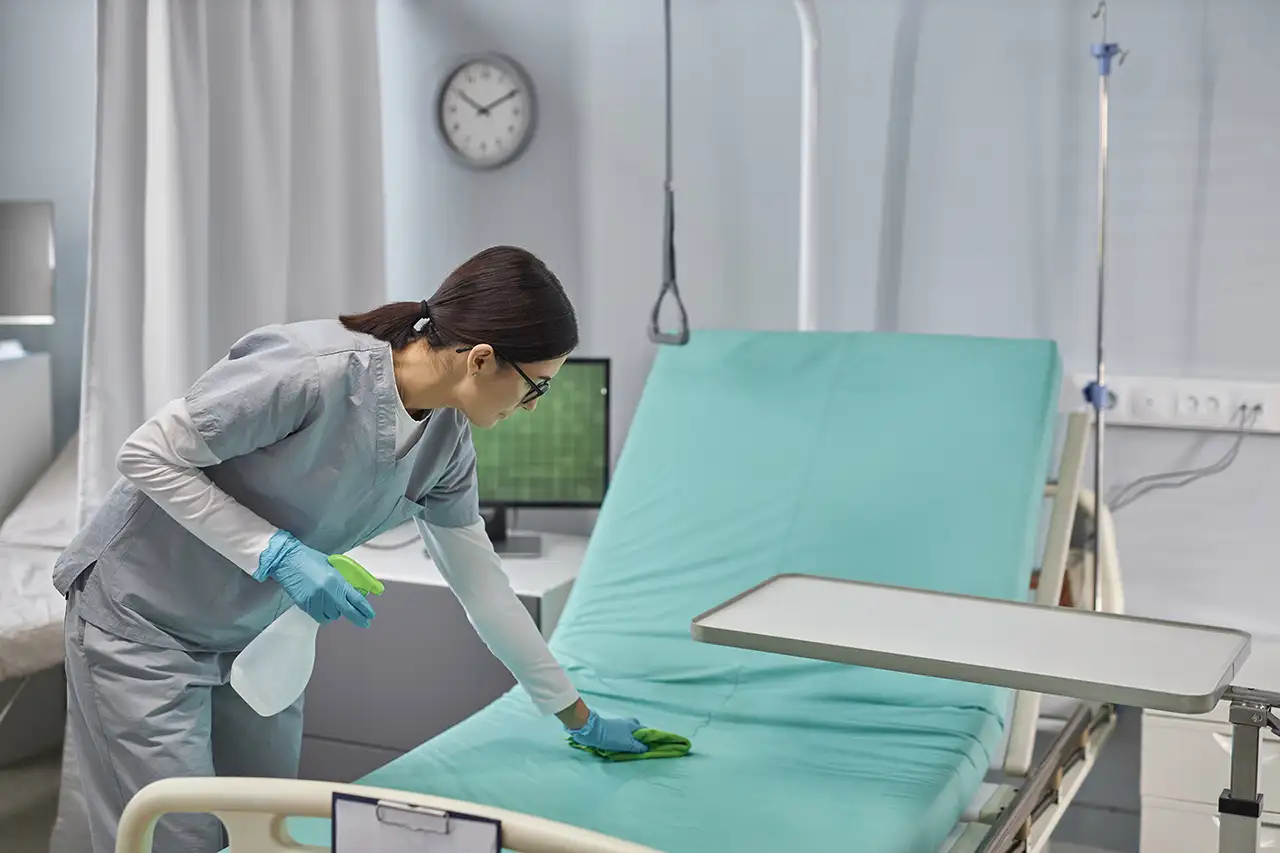
Commercial cleaning is presented as one industry, but the difference between an office, a warehouse, a restaurant, and a medical facility is not a matter of degree. It is different floor care, different frequencies, different regulations, and in healthcare and food service, different documented protocols. A company that has never cleaned a medical facility is not qualified to price one, regardless of how good their office work is.
We have worked across the Lehigh Valley since 2003 and serve Allentown, Bethlehem, Easton, Catasauqua and the surrounding towns, covering offices, medical facilities, warehouses, industrial sites, and construction cleanup. Our industries served page lists what we work in.
Why We Publish This
People ask us why we would publish a guide to choosing a cleaning company without using it to promote ourselves. It is a fair question, so here is the straight answer.
There are good cleaning companies in this region, and we are not going to pretend otherwise. We are also not the right choice for every building. A small office with one room and a weekly schedule may be better served by a two-person local operation that costs less than we would quote, and that would be an honest recommendation. A facility with compliance obligations needs something more rigorous than a standard janitorial scope, and it should be prepared to pay for it.
We publish this because the industry has a credibility problem, and it is not created by the good operators. It is created by unverifiable promises. Most cleaning companies are fine. The difficulty is that a client usually cannot tell the fine ones from the rest, because nobody is required to show their work. Written scopes, documented verification, real employment relationships and verifiable references are all available to you as buyer. Once you know to ask for them, the distinction becomes obvious — and you should be able to apply that same standard to every company you consider, including ours.
If you are unsatisfied with your current provider and open to a change, we are happy to look at your facility and tell you honestly whether we are a fit. Sometimes that answer is no.
(610) 657-5621